
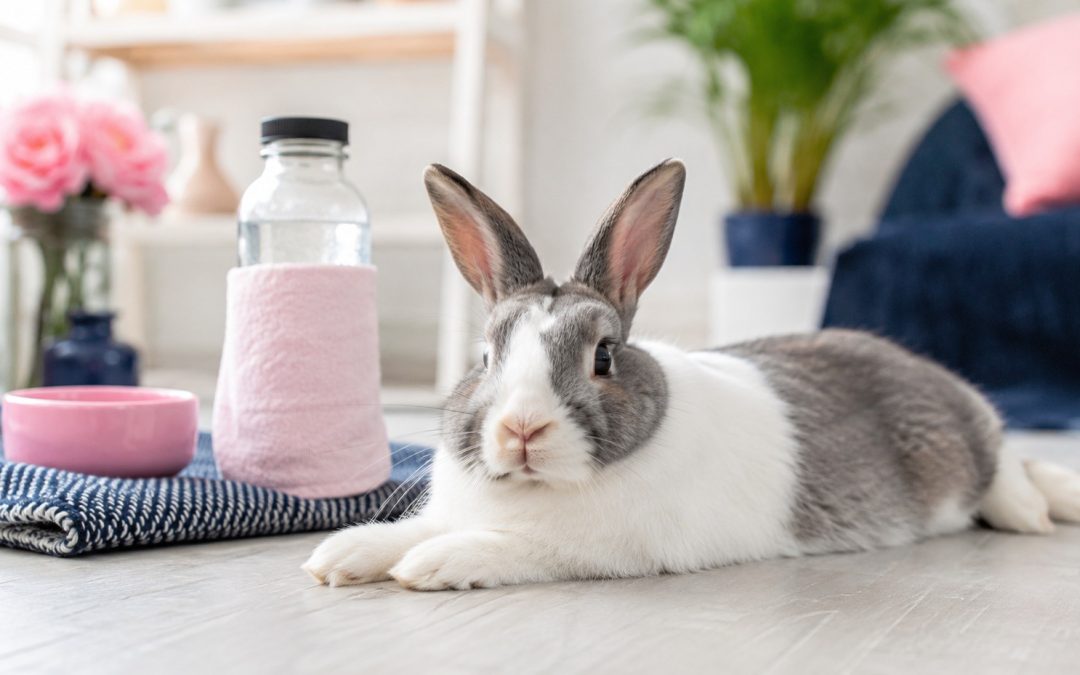
Rabbits have a public image problem. People picture them bouncing through sunny meadows, twitching their noses at wildflowers, living their best warm-weather life.
The reality is that your house rabbit would like summer to be over, please. Maybe two months ago.
Rabbits are surprisingly fragile in the heat — far more than most owners realize — and they are absolute champions at hiding it until things have gotten serious. Rabbit heat safety isn’t a “nice to know.” It’s a genuine, season-long responsibility, and the good news is that it’s mostly common sense once you understand why bunnies struggle so much. (If you also share your home with hamsters, guinea pigs, or other small pets, our guide to small pet heat stroke covers the same danger for the rest of the small-and-furry crew.) So let’s get into it, before the next heat wave does.
Why Rabbit Heat Safety Matters More Than You’d Think
Here’s the core problem: rabbits can’t cool themselves down the way other animals do. They don’t sweat. They don’t pant effectively the way dogs do. Their entire cooling system is, essentially, their ears.
Those big beautiful ears are packed with blood vessels, and rabbits dump excess body heat by circulating blood through them. It’s an elegant system. It is also not nearly enough when the temperature climbs, the humidity rolls in, and the only thing your rabbit has to work with is a pair of ears and a hopeful attitude.
Rabbits are genuinely comfortable somewhere around 60–70°F. Push past 75°F and they start to struggle. By the time you hit the mid-80s, you’re in dangerous territory — and a rabbit in true heat distress can decline frighteningly fast. This is the part that catches people off guard: “it’s only a little warm in here” is a human assessment. Your rabbit is running very different numbers.
Add in the fact that rabbits are prey animals — hardwired to never, ever look weak — and you’ve got a creature that will sit there quietly overheating rather than make a fuss about it. Which means the watching is on you. (It’s the same quiet-suffering problem we covered with older dogs in our post on senior dog summer heat — the pets who don’t complain are often the ones most at risk.)
The Warning Signs Every Rabbit Owner Should Know
Because rabbits hide distress so well, rabbit heat safety depends on you knowing the subtle signals. By the time a rabbit looks obviously unwell, the situation is already urgent.
Watch for these:
- Ears that feel hot to the touch or look very red and flushed — the cooling system working overtime
- Fast, shallow breathing — and especially breathing through an open mouth, which is a rabbit emergency, full stop
- Lethargy or stillness — lying stretched out flat, reluctant to move, “checked out”
- Drooling or wetness around the mouth
- Tossing the head back or showing obvious effort to breathe
- Refusing food or water, including favorites they’d normally never turn down
- Confusion, tremors, or weakness in the back legs — late-stage and very serious
Open-mouth breathing, convulsions, or unresponsiveness mean you skip everything else and get to an exotics vet immediately. With rabbits, heat emergencies are measured in minutes, not hours. Both the House Rabbit Society and PDSA have excellent rabbit heat safety guidance worth reading before you ever need it.
Rabbit Heat Safety: The Cooling Toolkit
Now the good news. Keeping a rabbit cool isn’t complicated or expensive — it’s just a handful of habits and a few cheap props. Here’s the toolkit.
Air conditioning is the foundation. Everything else on this list is a supplement. Reliable rabbit heat safety really does start here — if the room your rabbit lives in has steady AC, you’ve solved most of the problem already. Don’t crank the thermostat up to save money while you’re at work and assume the bunny will be fine — that warm afternoon room is exactly when rabbits get into trouble.
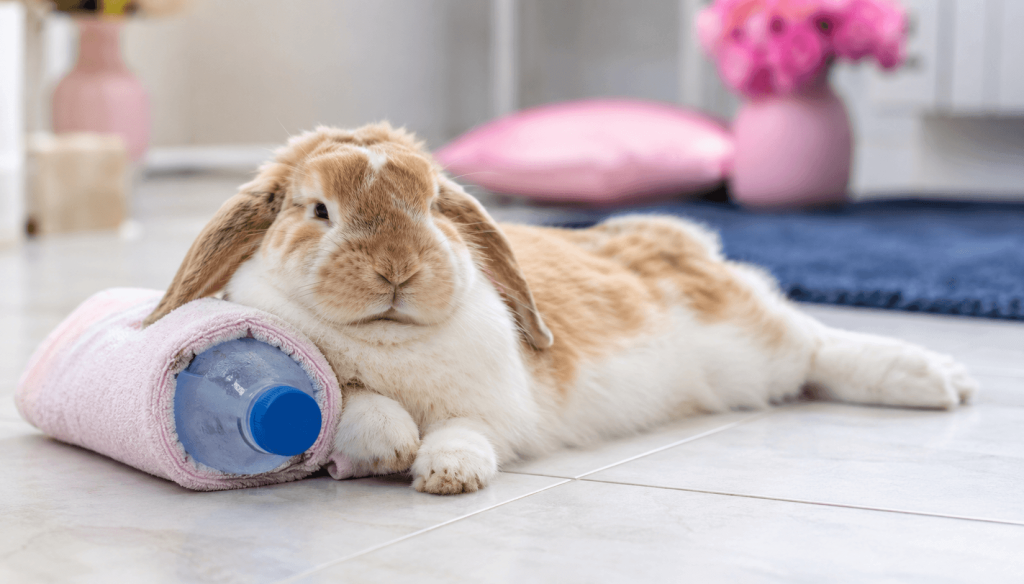
Frozen water bottles are a rabbit’s best friend. Fill a few plastic bottles, freeze them, wrap one in a thin towel, and set it in the enclosure. Your rabbit will lean against it, stretch out next to it, and generally treat it like the world’s best appliance. Rotate them as they thaw. This is the single cheapest, most effective tool you have.
Ceramic or marble tiles. A chilled ceramic tile gives your rabbit a cool surface to sprawl on. Keep one in the fridge and swap it out through the day. Rabbits figure these out immediately — there is no learning curve on “cold floor good.”
Mist the ears, gently. Lightly dampening your rabbit’s ears with cool water helps that built-in cooling system do its job. The ears, specifically — not soaking the fur, which rabbits hate and which doesn’t help anyway.
Fresh water, always, everywhere. Cool water, changed often, in more than one spot. Some rabbits drink more from a bowl than a bottle in summer — offer both. A few owners add a stray ice cube as enrichment, which rabbits find either fascinating or deeply suspicious, depending on the rabbit.
Watch the enclosure’s location. Move it away from windows and direct sun. A cage in a sunbeam can climb well past the room temperature. Airflow helps, but never point a fan directly at your rabbit — gentle circulation in the room, not a wind tunnel aimed at the bunny.
Rabbit Heat Safety Mistakes People Make With Good Intentions
A few well-meaning moves can actually backfire, so it’s worth naming the rabbit heat safety mistakes people make with the best of intentions.
Don’t dunk your rabbit in cold water. A sudden plunge into cold water can send an overheating rabbit into shock, which is its own emergency. Cool is the goal, not cold-shock. Mist the ears, offer cool surfaces, move them to AC — but no cold baths.
Don’t rely on a fan alone. Fans move air around, but rabbits don’t sweat, so a fan doesn’t cool them the way it cools you. A fan is a minor supplement to a cool room — never a substitute for one.
Don’t assume “shade” means “safe” outdoors. A shaded hutch on an 88°F day is still sitting in 88°F air. Outdoor rabbits are far harder to keep safe in summer heat, full stop — and on genuinely hot days, the right answer is bringing them inside.
Don’t forget the grooming. Long-haired breeds carry around a permanent wool sweater. Keeping them well-groomed and free of matting genuinely helps with rabbit heat safety — that excess fur is doing your bunny no favors in July.
When You’re Not Home to Watch the Bunny
Here’s the scenario that keeps rabbit owners up at night: it’s the hottest week of the year, you’re stuck at the office or away for the weekend, and your rabbit is home alone in a house where the AC may or may not be keeping up. Frozen bottles thaw. Water bowls get warm. Nobody’s there to notice the afternoon sun has shifted onto the enclosure.
This is exactly the kind of thing we built our cat sitting and small animal care service to handle. Rabbits aren’t an afterthought for us — our team understands rabbit heat safety, knows that “quiet” doesn’t mean “fine,” knows to check ear temperature and breathing, knows to swap the frozen bottles and refresh the water and confirm the room is actually staying cool. For longer absences, our in-home pet sitting means someone is physically there, multiple times a day, during the exact hours when heat does its damage. Older rabbits especially benefit from this kind of close attention — our Grey Muzzles and Wise Whiskers approach was made for pets who need a gentler, more watchful kind of care.
If a hot stretch of summer has you worried about your rabbit while you’re away, reach out and we’ll talk through a plan. Peace of mind during a heat wave is worth a quick conversation.
The Bottom Line on Rabbit Heat Safety
Rabbits will never tell you they’re too hot. It’s not in their nature — looking weak is how prey animals end up as somebody’s lunch, and a few thousand years of instinct doesn’t switch off just because they live in your living room now.
So rabbit heat safety comes down to you: a cool room, a few frozen bottles, a chilled tile, fresh water, and an eye on those ears. It’s a small set of habits that genuinely saves lives every summer.
Your bunny is counting on you to do the worrying for both of you. They’ll be too busy sprawled against a frozen water bottle, pretending this was their idea all along.



Recent Comments