
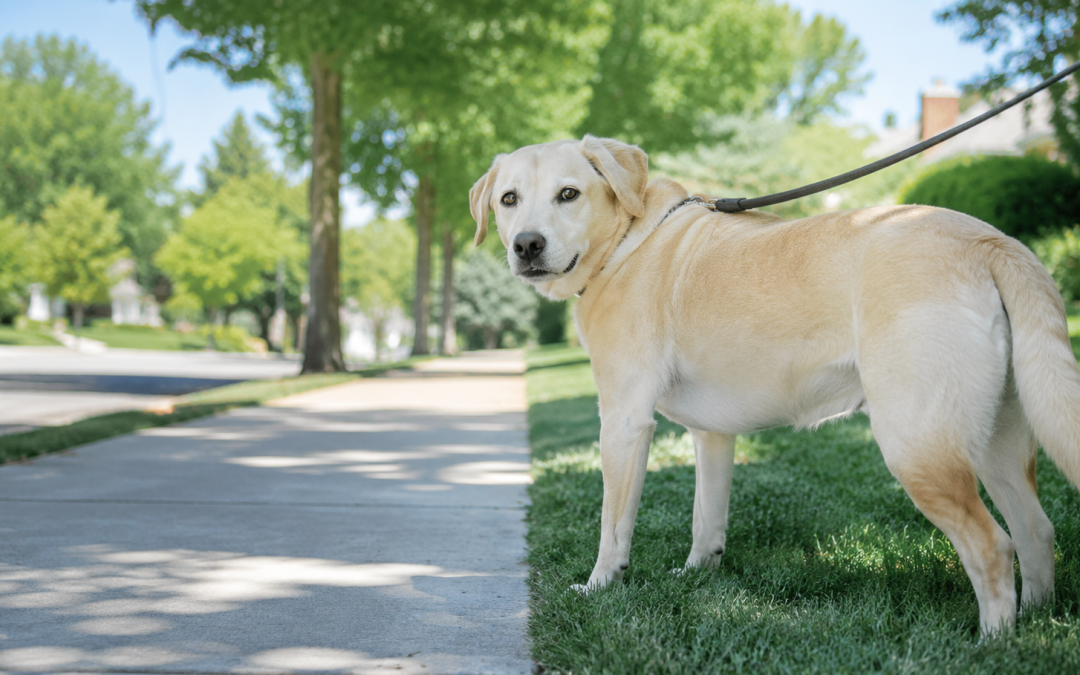
It’s 2 p.m. on a Tuesday in June. You’re standing at the door, leash in hand, and your dog is doing that little tap-dance that translates roughly to “let’s GO already.”
You step outside. The air hits you like a hairdryer set to spite. But the walk will be quick, the dog is excited, and the sidewalk is just… sidewalk. How bad could it be?
Bad. Surprisingly, devastatingly bad.
If you’ve never put your hand on a sun-baked sidewalk in late June, here’s what you’ve been missing: when the air temperature is 87°F, asphalt can hit 135°F. When it’s 95°F outside, that same asphalt can climb past 145°F. For context, an egg starts to fry at around 130°F.
Your dog is walking on a frying pan, and hot pavement for dogs is one of the most underestimated dangers of summer walks.
The Seven-Second Rule for Hot Pavement
Before every summer walk, do this: place the back of your hand flat against the pavement and hold it there for seven seconds.
If you can’t keep it there comfortably, your dog can’t walk on it.
That’s the entire test. No thermometer, no app, no guesswork. Just your hand, a sidewalk, and seven seconds of honesty.
We know — it feels almost too simple. But the seven-second rule has been around forever for a reason: it works. Your hand is roughly as sensitive as the pads of your dog’s feet, and if it hurts you, it’s actively burning them.
Why Paw Pads Aren’t As Tough As You Think
There’s a persistent myth that dogs have “tough” paws and can handle anything. This belief is usually held by people who have never actually examined a dog’s paw.
Hot pavement for dogs causes more vet visits in summer than most pet parents realize. Paw pads are made of thickened skin, but they’re still skin. They’re not made of leather, and they’re definitely not made of asbestos. They have nerve endings, blood vessels, and the same vulnerability to burns to sensitive pads as any other tissue.
The tricky part? Dogs are stoic. Really stoic. A dog with a burned paw will often keep walking — partly out of loyalty to you, partly because they’ve been told this is the walk and they want to do the walk. By the time they’re limping or refusing to move, the damage is already done.
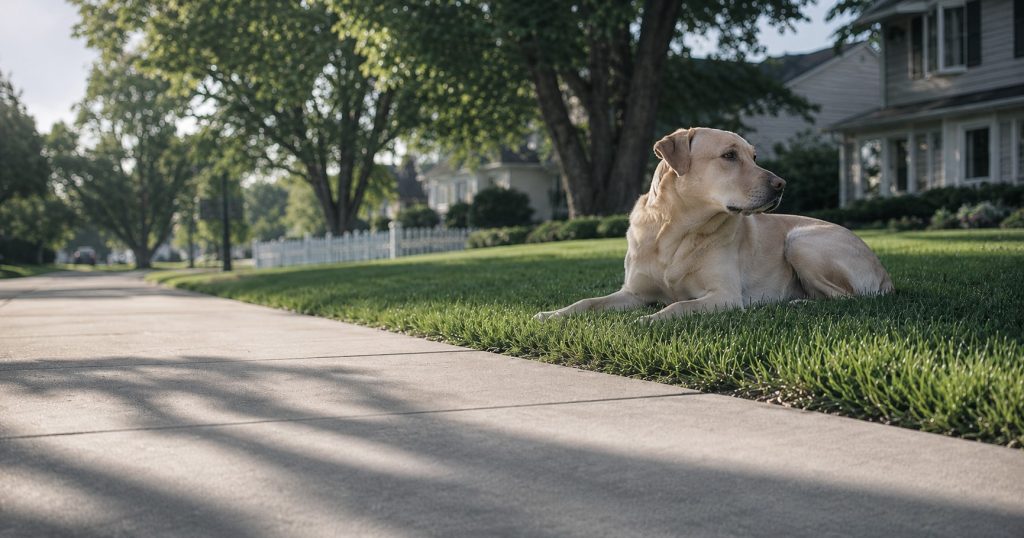
Common signs of paw pad burns from hot pavement for dogs include:
- Limping or favoring one paw
- Licking or chewing at the feet
- Pads that look darker, redder, or peeling
- Visible blisters or missing chunks of pad
- Reluctance to walk on hard surfaces
If you see any of these, the walk is over. Carry your dog if you can, and call your vet.
Hot Pavement for Dogs Is Sneakier Than You’d Expect
Here’s something every pet parent should know: it doesn’t have to be a heatwave for the pavement to be dangerous. A 75°F day with full sun can push asphalt past 110°F — already in the “burn risk” zone for sensitive pads. By 85°F, sidewalks are uncomfortable. By 90°F and up, they’re a genuine hazard.
And if you’ve spent any time around Northern Virginia in summer, you know the humidity does its own special thing. We’re not Phoenix-dry — we’re Mid-Atlantic-soggy. That means your dog is fighting heat and trying to cool down through panting in air that’s already saturated with moisture. It’s harder, slower, and less effective than the cooling system was designed for.
The real kicker: the time of day you’d assume is fine often isn’t. Pavement holds heat for hours after the sun starts to dip. A 7 p.m. walk on a 92°F day can still mean dangerously hot surfaces well into the evening, especially on dark asphalt and concrete that’s been baking since noon.
Better Walk Windows for Hot Pavement Days
When the forecast climbs, shifting your schedule is the simplest defense against hot pavement for dogs:
Best: Before 8 a.m. and after 9 p.m., when surfaces have had time to cool.
Acceptable: Shaded routes, grass paths, and shorter durations work well in mid-morning and late afternoon.
Requires expertise: Midday walks during peak summer heat, when hot pavement for dogs is at its most dangerous. These walks aren’t off-limits — they just need a professional who knows how to adapt routes, schedule around shade, and recognize heat stress early.
If your dog absolutely needs midday movement (puppies, high-energy breeds, dogs who’ll otherwise eat your couch), prioritize grass, dirt trails, or shaded paths. A short, slow walk in shade beats a fast walk in sun every time. Our Weekday Walk Club was built for exactly this — consistent midday breaks scheduled around the safest weather windows.
Signs Your Dog Is Overheating (Beyond the Paws)
Hot pavement burns are one risk. Heatstroke is a medical emergency, and it can happen frighteningly fast.
Watch for:
- Excessive panting that doesn’t slow down when you stop walking
- Drooling more than usual, especially thick or stringy drool
- Bright red gums or tongue
- Wobbling, stumbling, or seeming “off”
- Vomiting or diarrhea
- Collapse
If your dog shows any of these, get them to shade or air conditioning immediately, offer cool (not ice-cold) water, wet their paws and belly with cool water, and call your vet. Heatstroke is not something to “wait out.”
Some dogs are more vulnerable than others. Brachycephalic breeds — pugs, French bulldogs, English bulldogs, boxers — struggle with heat dramatically more than longer-snouted dogs. Senior pets, puppies, overweight dogs, and dogs with heart or respiratory conditions also need extra caution. We’ve got a whole post coming up just for the smush-faced crowd, but the short version is: when in doubt, stay in.
What to Do When the Walk Has to Happen Anyway
Sometimes the dog needs out, even when hot pavement for dogs is a real concern. Here’s how to make summer walks safer:
Stick to grass and shaded paths whenever possible. Carry water for both of you, and offer it often. Consider booties if your dog will tolerate them (many won’t, and that’s okay). Walk slower than usual — your dog isn’t trying to set a personal record, they’re just trying to enjoy the world.
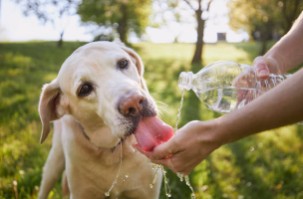
And honestly? Sometimes the smartest move is the boring one: a five-minute potty trip, a frozen Kong on the patio, and a long nap in the AC. Your dog won’t think less of you. They’ll probably think more of you.
When You Can’t Be the One Walking Them
Here’s where hot pavement for dogs becomes a logistical problem, not just a safety one. This is the part where a lot of pet parents start feeling guilty. You work full days. You’re stuck in meetings during the cool morning hours. By the time you get home, the pavement is still radiating heat from a long afternoon in the sun, and your dog has been holding it since 7 a.m.
That’s not a failure on your part. That’s just summer colliding with a regular work schedule.
This is exactly the gap a professional dog walker is built to fill — especially in summer, when getting midday walks right requires more skill, not less. Our team is out walking dogs across Fairfax, Vienna, Oakton, Burke, Chantilly, and Centreville every day, and we know which routes hold shade, which neighborhoods have grassy strips between sidewalks, and how to read a dog who’s telling us “I’m done” before they actually collapse.
We test the pavement before every summer walk, because hot pavement for dogs is something we take seriously every single day. We carry water. We adjust the route based on the dog in front of us, not the route we walked yesterday. And on the days when it’s just too hot to walk safely, we shift to indoor enrichment, potty breaks, and play instead.
Your dog still gets a midday break. You still get peace of mind. And nobody’s paws end up on a frying pan.
The Bottom Line on Hot Pavement and Your Dog
The seven-second rule for hot pavement for dogs takes about as long as it takes to read this sentence. Use it before every summer walk, every time, no exceptions. If the pavement is too hot for your hand, it’s too hot for your dog.
When the heat makes safe walks tricky, we’re here to help. Reach out anytime to set up midday walks, talk through a summer schedule, or just ask the kind of “is this too hot?” question we get every June.
Your dog’s paws will thank you. Probably with a nap.


Recent Comments